Goals
It’s always important to have goals in mind. Before every sprint, the team sat down and decided together on what we wanted to accomplish. We then proudly displayed our goals on the wall for all to see. Transparency is key. The goals for this sprint were as follows:
- Decide on a platform
- Research costume tagging solutions
- Create a foundation to build on for the project
Once we had the goals written down, we selected stories to work on that aligned with the goals. These stories were written on a notecard and added to our Kanban Board. The Kanban Board was essentially a few pieces of tape on a wall.
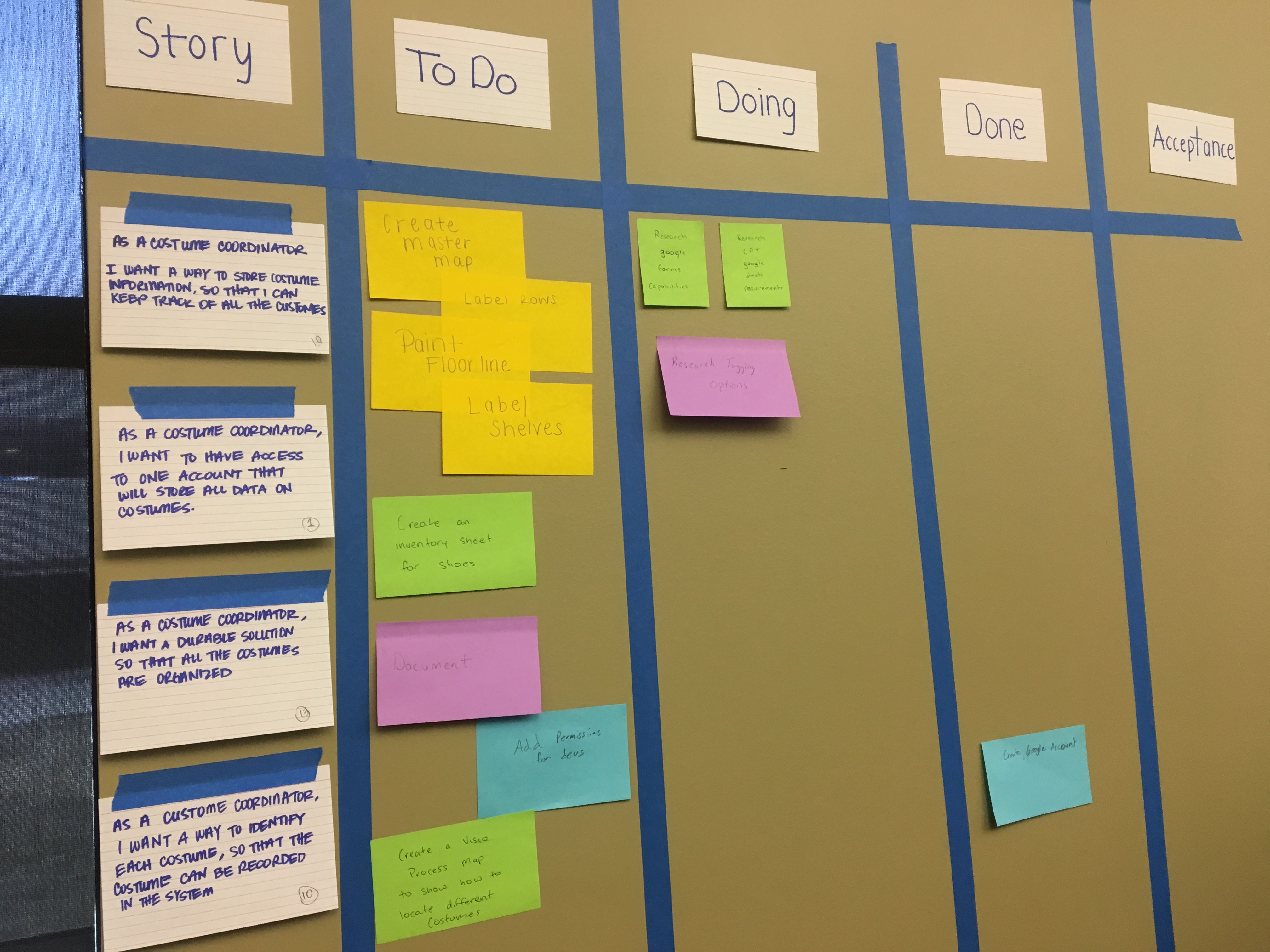
The Kanban Board was a direct representation of all the work being done in the sprint. If you wanted to know exactly what was happening at any point, just take a look at the board. The cards on the left were the user stories. The sticky notes represented the tasks that needed to be accomplished to be able to mark those user stories as done and accepted by the client. Is it the prettiest tool around? No. But it is efficient and effective!
Choosing a Platform
As the Product Owner, it was up to me to guide the product vision. The first step to getting started was choosing a platform for our system. The requirements here were tough. Community Players Theater had a tight tech budget and little to no existing technical infrastructure. Additionally, the theater did not have employees to maintain any complicated systems in the long run. This meant that running our system on physical servers wasn’t an option, and any complicated and expensive cloud solutions like AWS were right out.
Our solution: Google Suite. The services offered by Google included a spreadsheet app we could use like a database, a storage service for all of our files, a forms service that could collect all the data, and a scripting language that would allow us to link everything together. All of this was available on the cloud for the low, low price of free-ninety-nine. It was like a match made in heaven.
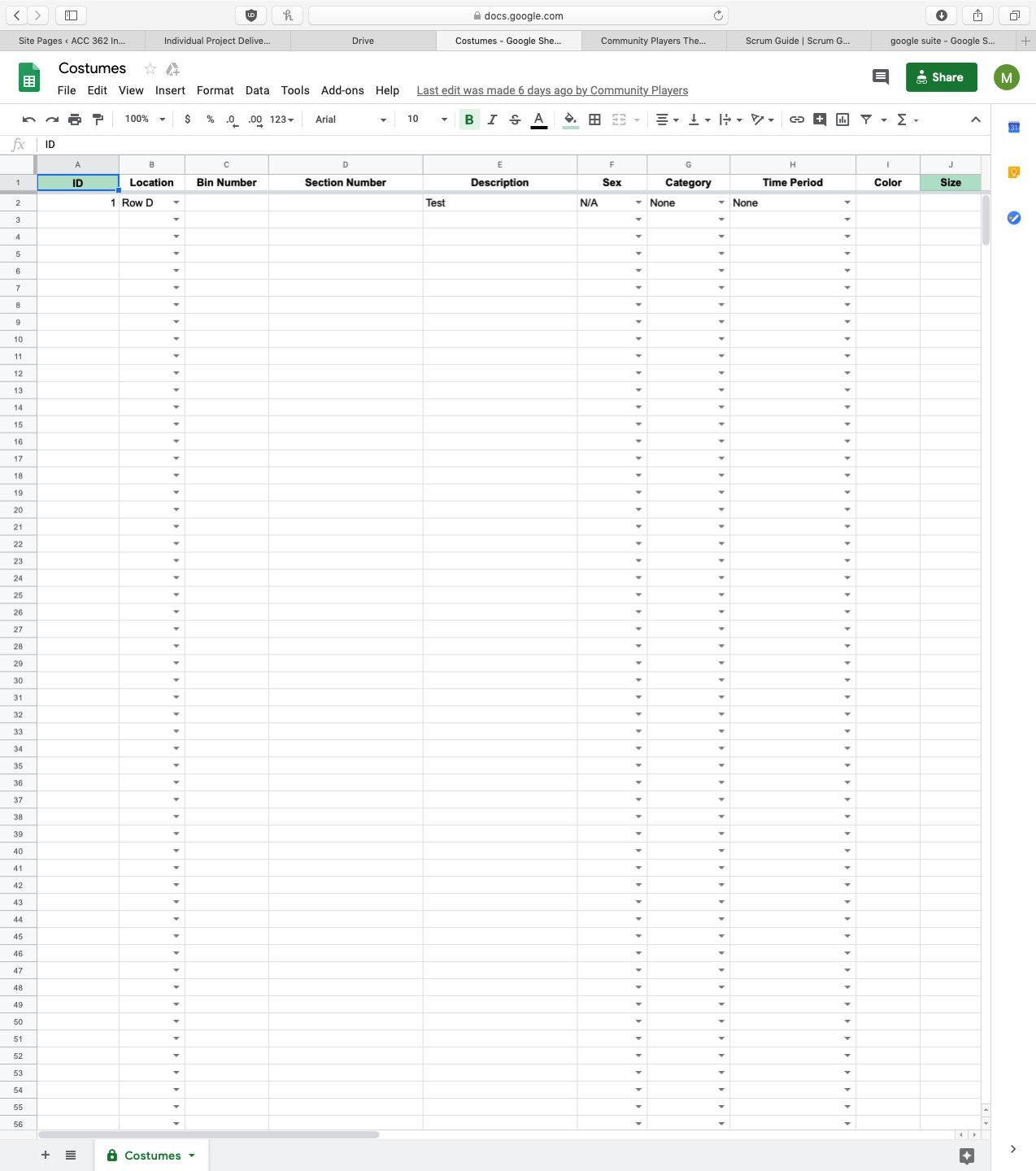
Andrew and Tom got to work on designing a spreadsheet that would function as a database for all the costumes. The columns of the spreadsheet denoted important information, such as costume ID, description, and location.
A Method to the Madness
Meanwhile, Christina and Silvia came up with a plan to inventory and organize the costume room. Since the racks were permanently mounted, we didn’t want to do much physical rearranging. Instead, Christina and Silvia assigned the rows letters. These letters could be recorded in the database, allowing the costume coordinator to lookup and quickly find a costume location.
Christina and Silvia created a map of the costume room for reference. Click on or download the file above to check it out! They also found some waterproof paint that could be used to paint the row letters on the floor of the costume room.
Zachary began devising a way to tag each individual costume. He proposed using either string tags, iron on labels, or fabric stickers.
Scrum Highlight – Sprint Review & Sprint Retrospective
At the end of each 2-week sprint, our team met up for the Sprint Review and the Sprint Retrospective.
Sprint Review
The Sprint Review comes first. At the review, the Scrum Team discusses all the work done during the sprint, and showcases what they built, if possible. The Scrum Team can choose who to invite to the meeting, but it is usually advantageous to bring in almost everyone involved with the project. This way the stakeholders can see what was produced and give the team feedback.
Sprint Retrospective
The Sprint Retrospective occurs next. We usually did our retrospective at the class meeting following the Sprint Review. This meeting involves only the Scrum Team. During the retro, the team discusses what went well and how the team can improve.
Our First Review
The team met at the theater with our professor and client to showcase our ideas for the project and what we had accomplished. Our client was very receptive to using Google Services and liked our idea on assigning letters to the costume rows. She gave us a few suggestions, such as using the iron-on tags over the string tags. Overall, the first review went really well!
Our First Retro
As the undisputed Master of Scrum, Andrew lead the team in a quick retro the following class period.
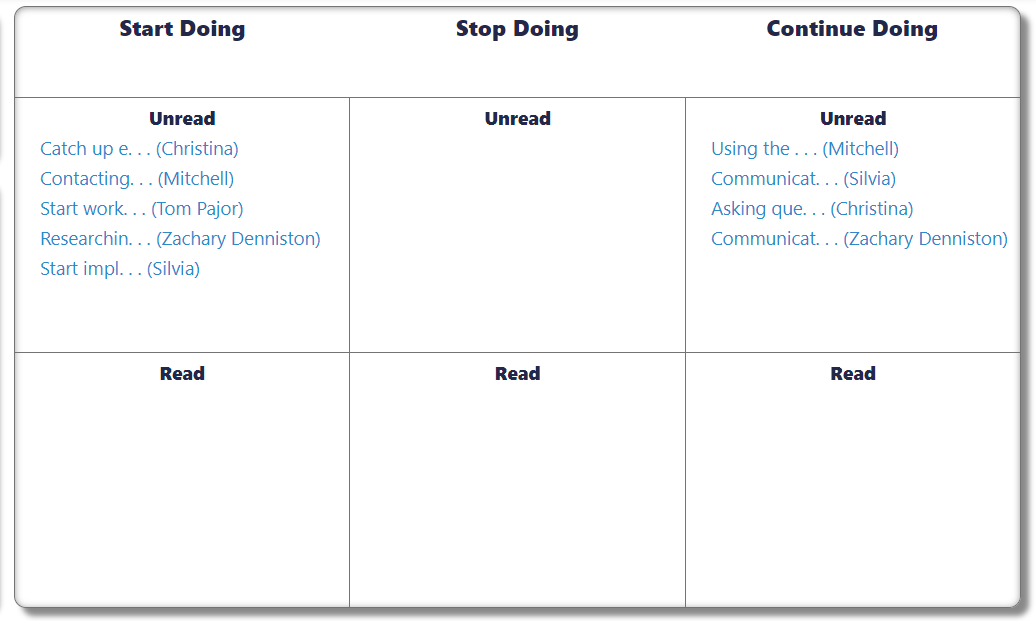
We used a tool called “Start Doing, Stop Doing, Continue Doing”. Each member logged onto a website and submitted their own critiques of the sprint. Afterwards, we discussed the responses as a group.
You might notice that no-one submitted anything for the Stop Doing category. Maybe we are all too nice… Other themes from the retro included to continue to communicate and to start coding!
Mitchell Milestone
The first sprint is simultaneously and paradoxically exciting and boring. It’s fun to kickoff and get going, but the first sprint is almost always marred with planning and design. This sprint was no different. A lot of the work consisted of research and asking questions.
My major contributions included selecting the platform and floating around helping the dev team with the system design. As the product owner, the first sprint is perhaps the most important. It set the stage for how the work would be done and the overall attitude of the team. I was really happy with how well the team was working together and the quality of the work produced. With a little planning out of the way, it was time to jump into the nitty-gritty with Sprint 2.
 ACC 362 Individual Project